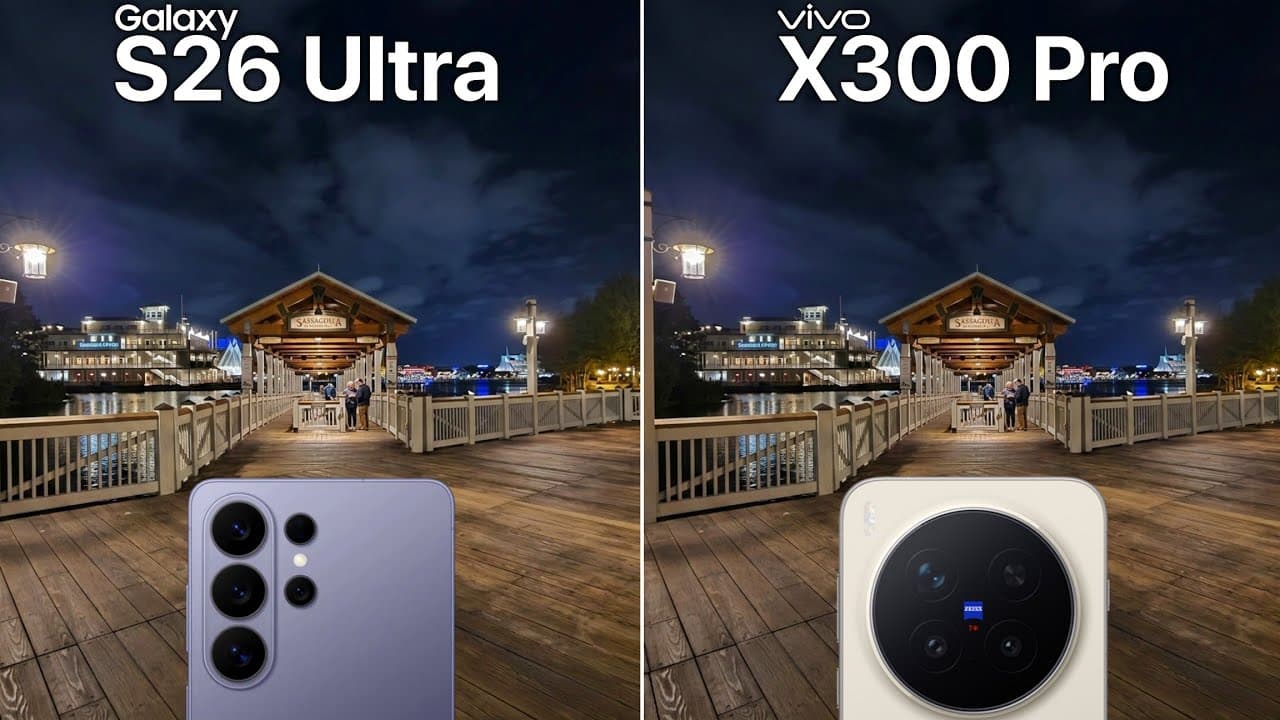
Vivo X300 Pro vs Samsung Galaxy S26 Ultra: Which One Should You Buy in India?
Quick answer
Buy the Vivo X300 Pro if camera quality, especially zoom and portraits, plus battery life and value matter most to you. Buy the Samsung Galaxy S26 Ultra if you want the S Pen, the built-in Privacy Display, a bigger QHD+ screen and Samsung's ecosystem, and you are fine paying a lot more for them.
On price alone, it is not close. The X300 Pro sells for ₹1,19,999 with 16GB RAM and 512GB storage. A 512GB Galaxy S26 Ultra now costs ₹1,74,999 after Samsung's September 2026 price hike. That is roughly ₹55,000 more for the same storage.
- Better camera, especially zoom: Vivo X300 Pro
- Better battery and faster charging: Vivo X300 Pro
- Better display and productivity: Galaxy S26 Ultra
- Better value for money: Vivo X300 Pro
- Longer software support: Galaxy S26 Ultra (7 years vs Vivo's 5 OS updates)
Two very different ideas of a flagship
If you are spending over a lakh on a phone, you are not really choosing specs. You are choosing what kind of phone you want to live with for the next four or five years.
The Vivo X300 Pro is a camera that happens to make calls. It launched in India on 2 December 2025, and nearly every decision Vivo made, from the 200MP ZEISS telephoto to the optional teleconverter kit, points at photography.
The Galaxy S26 Ultra, unveiled on 25 February 2026, is the all-rounder. It does not chase one headline spec. Instead it gives you a stylus, a giant QHD+ screen, a privacy filter built into the display and seven years of updates.
Below, we compare them the way you will actually use them: daily photos, a full day away from a charger, gaming on the commute and resale a few years down the line.
Price in India (October 2026)
The Vivo X300 Pro costs ₹1,19,999, while the Galaxy S26 Ultra starts at ₹1,54,999. Both phones cost more today than at launch. Samsung raised S26 series prices in late September 2026, citing rising memory costs, so expect online deals to swing.
|
Variant |
Vivo X300 Pro |
Galaxy S26 Ultra |
|---|---|---|
|
12GB + 256GB |
Not sold |
₹1,54,999 |
|
12GB + 512GB |
Not sold |
₹1,74,999 |
|
16GB + 512GB |
₹1,19,999 |
Not sold |
|
16GB + 1TB |
Not sold |
₹2,14,999 |
|
Launch price (base) |
₹1,09,999 |
₹1,39,999 |
|
Colours |
Dune Gold, Elite Black |
Cobalt Violet, Sky Blue, Black, White, Silver Shadow, Pink Gold |
Vivo sells just one variant, and it already has 512GB storage. With Samsung, matching that storage takes you to ₹1,74,999. Bank offers and exchange bonuses can cut either phone's price, and Samsung usually runs bigger ones, but the gap rarely closes completely.
Tip: If your budget is fixed around ₹1.2 lakh, the X300 Pro gets you a complete flagship. The same money buys only a heavily discounted Galaxy S26 Ultra base model, if you can find one.
Specs side by side
The biggest spec differences are battery size (6,510mAh vs 5,000mAh), charging speed (90W vs 60W) and the S26 Ultra's sharper, larger display with S Pen support.
|
Spec |
Vivo X300 Pro |
Galaxy S26 Ultra |
|---|---|---|
|
Display |
6.78-inch flat LTPO AMOLED, 2800 × 1260 (1.5K) |
6.9-inch Dynamic AMOLED 2X, 3120 × 1440 (QHD+), 120Hz, Privacy Display |
|
Processor |
MediaTek Dimensity 9500 |
Snapdragon 8 Elite Gen 5 for Galaxy |
|
RAM + storage |
16GB + 512GB |
12GB + 256GB / 512GB, 16GB + 1TB |
|
Main camera |
50MP Sony LYT-828, 1/1.28-inch, f/1.57, gimbal OIS |
200MP, f/1.4 |
|
Ultra-wide |
50MP, f/2.0, autofocus |
50MP, f/1.9, autofocus |
|
Telephoto |
200MP, 1/1.4-inch, 85mm (about 3.7x), f/2.67, OIS |
10MP 3x + 50MP 5x periscope |
|
Front camera |
50MP with autofocus |
12MP class |
|
Video |
Up to 8K 30fps, 4K 120fps Dolby Vision |
Up to 8K |
|
Battery |
6,510mAh |
5,000mAh |
|
Wired charging |
90W |
60W |
|
Wireless charging |
40W, plus reverse wireless |
25W, Qi2 via magnetic case only |
|
Stylus |
No |
S Pen built in |
|
Durability |
IP68 + IP69 |
IP68, Gorilla Glass Armor 2 |
|
Weight, thickness |
226g, 7.99mm |
214g |
|
Software |
OriginOS 6 (Android 16) |
One UI 8.5 (Android 16) |
|
Updates promised |
5 Android versions, 7 years security |
7 years OS and security (till 2033) |
Design and build
The S26 Ultra is the lighter phone at 214g, despite the bigger screen. The X300 Pro weighs 226g.
Samsung moved back to an aluminium frame this year and rounded off the sharp corners that older Ultras were known for. It is the slimmest Ultra so far, and it feels noticeably easier to hold than the S25 Ultra.
The X300 Pro has a flat screen, a large centred camera ring and an Action Button you can map to the camera or other shortcuts. That camera bump is big, so the phone wobbles on a table without a case.
On toughness, Vivo has the edge. The X300 Pro carries both IP68 and IP69 ratings, so it can handle high-pressure, hot water jets as well as a dunk in water. The S26 Ultra is IP68 and uses Gorilla Glass Armor 2, which also cuts reflections nicely.
Display: Samsung's Privacy Display is the real story
The S26 Ultra has the better screen overall: larger, sharper (QHD+ vs 1.5K) and paired with the S Pen.
Its headline feature is the Privacy Display, the first one built into a phone's panel. Switch it on and anyone looking from the side sees a dark screen, while you see it normally. You can set it to turn on automatically for banking, UPI or chat apps. If you take the metro daily or work with sensitive data, this is genuinely useful.
There is a catch. Reviewers found that with Privacy Display on, the screen gets dimmer and colours shift a little, and it uses roughly 15% more power. Most people will use it only in specific apps.
The X300 Pro's 6.78-inch LTPO AMOLED panel is very bright and looks excellent in Indian sunlight. Its lower 1.5K resolution is hard to notice in daily use. The flat design also means fewer accidental touches than curved screens.
Cameras: the X300 Pro wins, mainly on zoom
For most photos you take, the Vivo X300 Pro produces the more natural, more detailed result, and its telephoto is in a different league.
Main camera. Vivo uses a new 50MP Sony LYT-828 sensor with ZEISS optics and a dedicated imaging chip. Reviewers praise its dynamic range and low-light shots. Samsung's 200MP main camera is sharp and reliable, but Samsung kept the camera hardware largely the same as last year, and some reviewers felt it should be stronger at this price.
Zoom. This is where the two split. The X300 Pro's 200MP telephoto uses a 1/1.4-inch sensor, among the largest ever fitted to a phone telephoto. At its native 85mm it is ideal for portraits, food and street photos, and it even does telephoto macro. Samsung uses two zoom cameras, a 10MP 3x and a 50MP 5x periscope. The 5x is handy for distant subjects, but the 3x camera is showing its age.
Teleconverter. Vivo sells an optional ZEISS 2.35x Telephoto Extender kit that clips on and stretches the telephoto to about 200mm. It suits wildlife, concerts and sports, and Samsung has nothing like it.
Selfies and video. The X300 Pro's 50MP selfie camera now has autofocus, which is great for group shots. For video, Vivo records 4K at 120fps in Dolby Vision. Samsung's video remains very stable and consistent across lenses, and its Horizon Lock feature keeps footage level while you move.
Bottom line: If photos are your main reason to spend this much, pick the X300 Pro. Samsung's cameras are dependable, but they are not its strongest selling point this year.
Performance and gaming
Both phones are as fast as Android gets in 2026, and you will not feel a difference in daily use.
The S26 Ultra runs a special Snapdragon 8 Elite Gen 5 for Galaxy chip, with slightly higher clock speeds than standard. In one review it scored about 3,641 single-core and 10,959 multi-core on Geekbench 6. Samsung has also improved heat management, so long gaming sessions stay smooth.
The X300 Pro uses MediaTek's Dimensity 9500 with 16GB RAM as standard. Reviewers report it handles heavy games without trouble.
One small edge goes to Samsung: Snapdragon chips tend to get game optimisations first in India. If you play BGMI or Genshin Impact at maximum settings every day, the S26 Ultra is the safer pick. For everyone else, it is a tie.
Battery and charging
The X300 Pro wins on paper and in practice, with a 6,510mAh battery and 90W charging against Samsung's 5,000mAh and 60W.
To be fair to Samsung, the S26 Ultra's battery life improved this year even with the same capacity, because the new chip is more efficient. Several reviewers got close to two days with mixed use. Its 60W charging now fills the phone in under an hour.
Still, a 30% bigger battery is hard to beat. Heavy users who shoot lots of photos, navigate and stream on the go will find the X300 Pro ends the day with more to spare.
Wireless charging is also stronger on the Vivo (40W vs 25W), and it can charge other devices wirelessly too. Note that neither phone has built-in magnets for Qi2 charging, so you need a magnetic case for MagSafe-style accessories.
Software, AI and updates
Samsung leads on long-term support, promising 7 years of Android and security updates for the S26 Ultra, through 2033. Vivo promises 5 Android version upgrades and 7 years of security patches for the X300 Pro.
One UI 8.5 is polished and packed with Galaxy AI features such as call translation, note summaries and photo editing tools. The S Pen adds handwriting, quick notes and precise photo edits, though it no longer works as a Bluetooth remote.
OriginOS 6 on the X300 Pro is smooth and clean, with good camera and photo editing tools. However, Samsung's service network across India, from metros to smaller towns, is wider, and that matters when something breaks in year three.
Resale is worth a thought too. Samsung Ultras usually hold value better in India's used-phone market, which narrows the real cost gap when you sell or exchange later.
Which one should you buy?
Choose the Vivo X300 Pro if you:
- Care most about photos, especially portraits, zoom and low light
- Want the biggest battery and fastest charging
- Want 512GB storage without paying ₹1.75 lakh
- Like the idea of a clip-on teleconverter for wildlife or concerts
- Want IP69 protection for dusty, rainy or rough conditions
Choose the Samsung Galaxy S26 Ultra if you:
- Use a stylus for notes, signatures or sketching
- Want privacy on public transport or at work, built into the screen
- Plan to keep the phone for 5 to 7 years and want the longest updates
- Already use a Galaxy Watch, Buds, Tab or Samsung laptop
- Value strong resale and a wide service network across India
Final verdict
For most buyers in India, the Vivo X300 Pro is the better buy. It has the better camera, the bigger battery, faster charging and 512GB storage, and it costs about ₹55,000 less than a 512GB S26 Ultra.
The Galaxy S26 Ultra earns its price only if you will use what Vivo cannot offer: the S Pen, the Privacy Display, the sharper QHD+ screen, seven years of updates and Samsung's after-sales reach. For business users and people who keep phones for many years, that can be worth the extra money.
One timing note: Vivo is launching its X500 series in China this month, and the Galaxy S27 is expected early next year. If you are not in a hurry, prices on both current models may soften once their successors arrive.