Phones / Apple
iPhone 18 Pro vs iPhone 17 Pro: how the specs and price actually compare
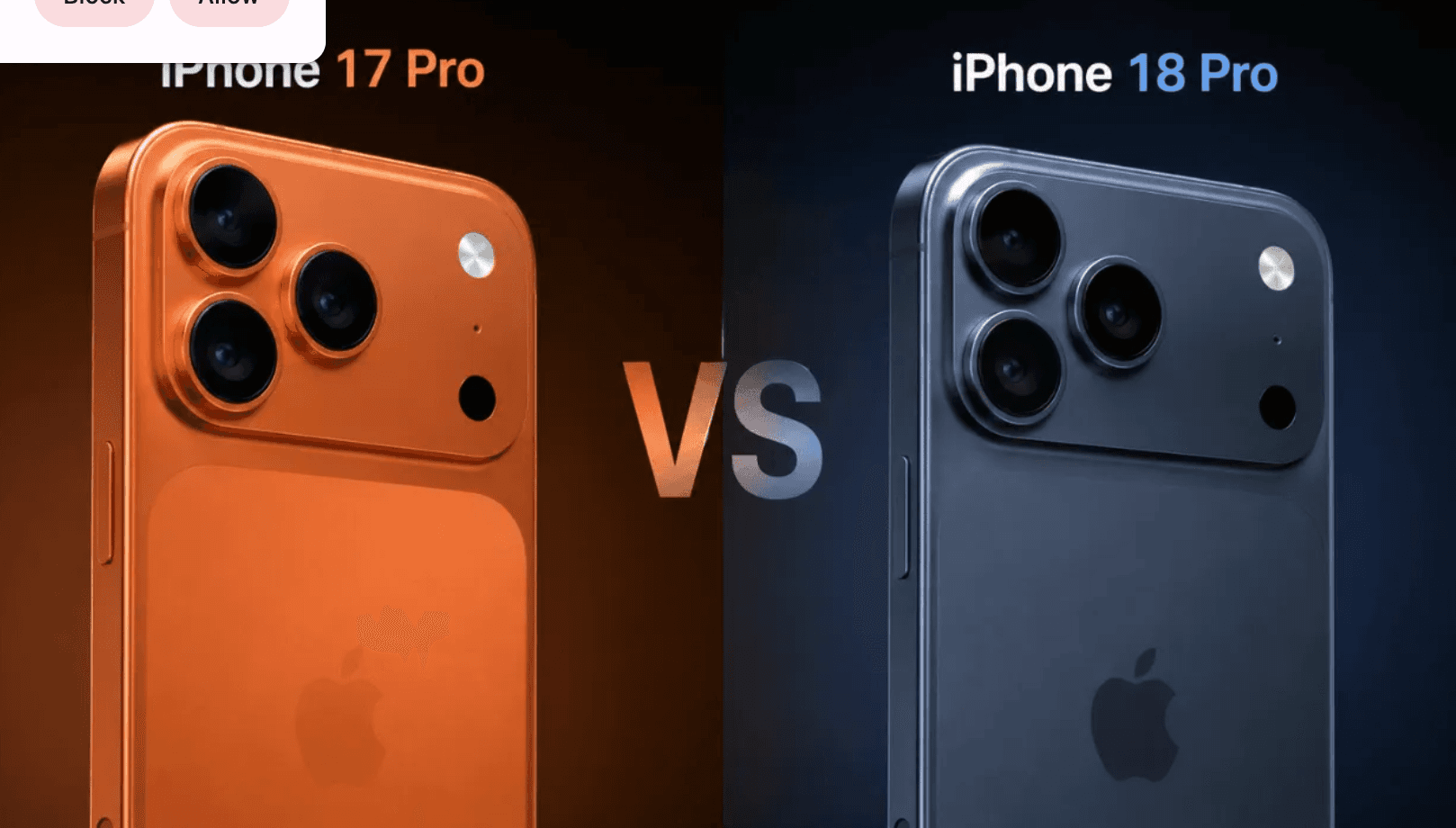
The iPhone 18 Pro is an internal upgrade to a body you have already seen. It keeps the iPhone 17 Pro's 6.3-inch screen, aluminium unibody and triple 48-megapixel camera layout, and changes what sits underneath: a 2-nanometer A20 Pro chip reported to be around 18% faster and 30% more efficient, a more power-frugal LTPO+ panel, a new C2 modem with satellite 5G, and a variable aperture main camera.
On price, the iPhone 17 Pro launched at $1,099 / £1,099 / ₹1,34,900 for 256GB. Forecasts for the iPhone 18 Pro run from unchanged to $300 higher. Bloomberg's most recent reporting suggests Apple will settle on about $100 more, or roughly $1,199. Apple confirms everything at its event on 9 September 2026.
There is an awkward truth at the heart of this comparison, and it is better to state it in the first paragraph than bury it: one of these two phones does not exist yet.
The iPhone 17 Pro has been on sale since 19 September 2025. Every number attached to it is measured, tested and warrantied. The iPhone 18 Pro has an event date and not much else that Apple has put its name to. What follows is drawn from supply-chain filings, dummy units, CAD leaks and analyst notes, all of which have a decent but imperfect track record. So this article marks its sources of confidence visually, and you should treat the two colours differently.
Shipping hardware, verifiable today Expected, not yet confirmed by Apple
The full specification comparison
Read this table with the launch dates in mind. The left column is a review unit; the right column is the industry's best current estimate.
| Specification | iPhone 17 Pro | iPhone 18 Pro |
|---|---|---|
| Status | Released 19 Sept 2025 | Event 9 Sept 2026; on sale expected 18 Sept |
| Display | 6.3in Super Retina XDR OLED, LTPO, ProMotion 1–120Hz, 3,000 nits peak outdoor | 6.3in, same size and resolution, upgraded LTPO+ panel for lower power draw |
| Front cutout | Dynamic Island, ~20.7mm widget | Possibly ~35% narrower (~13.5mm); disputed. No under-display Face ID |
| Chip | A19 Pro, 3nm. 6-core CPU, 6-core GPU with Neural Accelerators, 16-core Neural Engine | A20 Pro, TSMC 2nm with WMCM packaging. ~18% faster, ~30% more efficient |
| Memory | 12GB LPDDR5X | 12GB, expected to move onto the chip wafer itself |
| Storage | 256GB / 512GB / 1TB | Same tiers. No capacity bump expected |
| Rear cameras | 48MP Fusion Main, 48MP Ultra Wide, 48MP Telephoto (4x optical, 8x optical-quality) | Same trio, plus variable aperture on the Main and a wider telephoto aperture |
| Front camera | 18MP Center Stage, Dual Capture | 18MP, unchanged |
| Battery | 4,252mAh (US) / 3,988mAh (SIM-tray markets). Up to 31h video playback | 4,288mAh (US) / 4,056mAh (China) per regulatory filings |
| Charging | 50% in 20 min with a 40W adapter; MagSafe; Qi2 | No change reported |
| Modem | Qualcomm Snapdragon X80 | Apple C2, with satellite 5G (NR-NTN). Qualcomm possible in the US for mmWave |
| Wireless | Apple N1: Wi-Fi 7, Bluetooth 6, Thread | Apple N2, improvements undisclosed |
| Cooling | Laser-welded vapor chamber in aluminium unibody | Vapor chamber retained, possibly larger |
| Body | 150.0 × 71.9 × 8.75mm, 206g, IP68 | ~8.8–9.0mm thick; camera plateau ~2mm deeper |
| Back finish | Two-tone: Ceramic Shield panel against aluminium | Seamless, frosted, colour-matched. Two-tone look dropped |
| Camera Control | Pressure, touch and haptic feedback | Simplified to pressure only |
| Colours | Cosmic Orange, Deep Blue, Silver | Dark Cherry, Light Blue, Dark Gray, Silver |
| Software | Shipped with iOS 26 | iOS 27, with the rebuilt Siri |
| Launch price, 256GB | $1,099 / £1,099 / ₹1,34,900 | $1,099 to $1,399 depending on whose forecast you believe |
Where the money actually goes: the A20 Pro
The A20 Pro is expected to be the first Apple silicon built on TSMC's 2-nanometer node, and the first to use Wafer-Level Multi-Chip Module packaging, which puts the RAM on the same wafer as the CPU, GPU and Neural Engine instead of alongside it. Reported gains are roughly 18% more performance and 30% better efficiency over the A19 Pro.
Two things are worth separating here. The performance figure is the one Apple will put on a slide, and it is the one you will notice least. The A19 Pro already delivers up to 40% better sustained performance than its predecessor because of the vapor chamber, and almost nobody is bottlenecked by it. If you export video on your phone or play something demanding for an hour at a time, 18% is real. For everything else it is a benchmark number.
The efficiency figure is the interesting one, and it compounds with the display change. A 30% more efficient chip paired with an LTPO+ panel that idles at lower power is how you get meaningfully longer battery life out of a cell that has barely grown. Note the battery numbers in the table: the iPhone 18 Pro's 4,288mAh is a rounding error above the 17 Pro's 4,252mAh. Any battery gain in the smaller Pro will come from silicon and screen, not capacity. The Pro Max is the model getting the physically bigger cell, up almost 10%.
There is a cost to all of this, and it lands on the buyer. TSMC has reportedly told Apple that 2nm wafers price at least 50% higher than 3nm. One estimate has the application processor alone rising from about $50 to $85 per unit. That is the first of two reasons this year's Pro may cost more.
The camera change that could matter more than the chip
The iPhone 17 Pro's camera system is already unusually complete. Three 48-megapixel sensors, a telephoto that reaches 4x optically and 8x at optical quality, 48MP macro, and an 18MP front camera that reframes group shots automatically.
The iPhone 18 Pro is expected to add a variable aperture to the Main camera: a mechanical iris that physically changes how much light reaches the sensor, rather than faking depth of field in software. Apple is also reported to be widening the telephoto's aperture, and at least one Samsung-developed three-layer stacked sensor is in the mix.
A mechanical iris on a phone is a genuinely new capability rather than a bigger number, and that is why it is worth paying attention to. Right now, shooting a bright scene on an iPhone means the shutter speed does all the work, and you have no way to hold a wide aperture open for shallow depth of field without blowing out the highlights. A variable aperture fixes that. It also lets you stop down to get a sharper, deeper focus across a landscape or a document.
Now the caveat, which the enthusiast coverage tends to skip. Phone sensors are small. Depth of field on a sensor that size is already deep, so the practical difference between f/1.8 and f/4 on an iPhone is far less dramatic than the same change on a full-frame camera. Expect a useful tool for controlling exposure and diffraction, not a portrait-lens replacement. And note one unconfirmed but plausible wrinkle: a Chinese leaker has suggested the variable aperture may be exclusive to the Pro Max. Apple has split camera hardware between Pro models before, most notably when the iPhone 15 Pro did not get the tetraprism telephoto.
Satellite 5G, and the feature nobody is talking about
The C2 modem is expected to bring NR-NTN support, meaning full internet over satellite rather than just emergency messaging. Reports say third-party apps will be able to use the connection, along with Apple Maps and Photos.
If that ships as described, it is the single most consequential change on this list for a specific group of people: anyone who works, hikes, drives or farms outside reliable coverage. Going from "I can text for help" to "I can load a map and send a photo" is a category change, not an increment.
Alongside it comes the Limit Precise Location setting that arrived with the C1X, which restricts the location granularity your carrier can see. It reduces you from an address to a neighbourhood. It is a quiet privacy feature that depends on carrier support, and worth checking against your own operator before you count on it.
The price question, and why the experts disagree
This is where the comparison gets genuinely uncertain, and where most articles on the subject pick one forecast and present it as fact. The honest position is that four credible parties have published four different answers within the last few months.
The bull case for a big increase is a supply problem, not an Apple decision. AI data centres have consumed the memory market. According to TrendForce, memory made up roughly 10% of an iPhone's bill of materials a year ago; by the third quarter of 2026 it was about 34%, and it is forecast to pass 40% by early 2027. Memory has overtaken both the processor and the display as the most expensive component in the phone. TrendForce puts the 256GB iPhone 18 Pro's build cost about 38% above the iPhone 17 Pro's.
The bear case is competitive discipline. Samsung held the Galaxy S26 Ultra at $1,299 for 256GB and raised only the higher-capacity tiers. Google took a $100 rise on the Pixel 10 Pro XL. Apple has also just launched a $599 MacBook Neo and a $599 iPhone 17e, absorbing cost to hold price points, which is what led Ming-Chi Kuo to argue Apple may keep the Pro flat and take the market share instead. Bloomberg's framing lands between the two: a rise is inevitable, but a $100 rise keeps Apple in Samsung's neighbourhood and avoids the sticker shock it accepted on Macs and iPads.
My read, for what it is worth: $1,199 is the most likely landing spot for the iPhone 18 Pro, with a real chance Apple protects the 256GB headline and takes more margin on 512GB and 1TB. Watch the upper tiers, not the entry price.
| Capacity | iPhone 17 Pro, at launch | iPhone 18 Pro, +$100 scenario |
|---|---|---|
| 256GB | $1,099 / £1,099 / ₹1,34,900 | $1,199 / £1,199 / ₹1,39,900 (est.) |
| 512GB | $1,299 / ₹1,54,900 | $1,399 / ₹1,59,900 (est.) |
| 1TB | $1,499 / ₹1,74,900 | $1,599 / ₹1,79,900 (est.) |
A note for readers in India
Indian pricing does not track US pricing cleanly, and 2026 has been a rough year for it. Apple raised Mac, iPad and Apple TV prices earlier in the year, and India absorbed the steepest increases in that round. A $100 US rise has historically translated to something closer to ₹5,000–₹10,000 locally once duties and the exchange rate are applied. Current estimates put the iPhone 18 Pro's Indian entry price near ₹1,39,900, but treat that as an informed guess.
One practical point that applies everywhere: MacRumors has reported that Apple may raise prices on older iPhone models to offset component costs, which would be a first. The usual strategy of waiting for the new model so the old one gets cheaper may not work this year. If the iPhone 17 Pro at its current street price suits you, buying before 9 September is a defensible move.
So which one should you buy?
Buy the iPhone 17 Pro now if…
You are upgrading from an iPhone 14 Pro or older, you want the Cosmic Orange or Deep Blue finish before they disappear, or you simply want the best price-to-capability ratio available. The 17 Pro has the vapor chamber, the 8x zoom, the 3,000-nit screen and 12GB of RAM. It will get iOS 27 and years of updates after that. Nothing in the 18 Pro rumour list makes it feel dated.
Wait for the iPhone 18 Pro if…
You shoot photography seriously and want the variable aperture. You spend time outside cellular coverage and satellite internet would change how you work. You keep phones for four or five years and want the newest silicon at the start of that run. Or you are on an iPhone 16 Pro or 17 Pro, in which case there is no urgency at all and you may as well see what Apple announces.
Skip both if…
You are on an iPhone 17 Pro today. This is the smallest year-over-year Pro upgrade in some time, and paying a probable premium for 18% more speed you will not feel is a poor trade. Check back for the iPhone 19 Pro, which is where the slimmer Dynamic Island and possibly under-display Face ID are now expected to land.
Key dates
- Wednesday 9 September 2026, 10:00 PT — Apple's event. Confirmed. The iPhone 18 Pro, iPhone 18 Pro Max and the first foldable iPhone are expected.
- Friday 11 or Saturday 12 September — pre-orders. Apple has historically avoided 11 September, and this year is the 25th anniversary, so a Saturday start is plausible.
- Friday 18 September 2026 — most likely retail availability for the Pro models.
- Q4 2026 — the foldable iPhone may go on sale later than the Pro models, according to Ming-Chi Kuo, because of production constraints.
- Around March 2027 — the standard iPhone 18, iPhone 18e and second-generation iPhone Air. There is no regular iPhone 18 this September.
Frequently asked questions
Is the iPhone 18 Pro worth the upgrade from an iPhone 17 Pro?
For most people, no. You would be paying a likely premium for a faster chip, a more efficient panel, a variable aperture lens and satellite 5G, on a phone with the same screen, same cameras on paper, and the same design. If satellite connectivity or the aperture control solves a real problem for you, it changes the calculation. Otherwise, skip a generation.
Will the iPhone 18 Pro have under-display Face ID?
No. Earlier rumours pointed that way, but more recent reporting says the technology is not ready. The most that may happen is the Face ID flood illuminator moving beneath the screen, which would allow a narrower Dynamic Island. Even that is contested.
How much faster is the A20 Pro than the A19 Pro?
Reports point to roughly 18% faster with about 30% better power efficiency, thanks to the move from a 3nm to a 2nm process and new on-wafer memory packaging. Treat both figures as estimates until Apple publishes its own.
Does the iPhone 18 Pro have a bigger battery than the iPhone 17 Pro?
Barely. Regulatory filings point to 4,288mAh versus 4,252mAh on US models, which is negligible. The iPhone 18 Pro Max is the model with a real increase, to roughly 5,567mAh from 5,088mAh. Expect the smaller Pro's battery gains to come from chip and display efficiency instead.
Is the iPhone 18 Pro thicker than the iPhone 17 Pro?
Probably slightly. Estimates range from 8.8mm to 9.0mm, against 8.75mm on the iPhone 17 Pro. The more noticeable change is the camera plateau, which dummy units suggest is around 2mm deeper.
Will my iPhone 17 Pro case fit the iPhone 18 Pro?
Do not count on it. OtterBox has listed its iPhone 17 Pro cases as compatible, but a deeper camera plateau and a marginally thicker body mean any case with a snug camera cutout is likely to fight you.
What happened to the regular iPhone 18?
Apple has split its release calendar. Only Pro models and the foldable arrive in September 2026. The standard iPhone 18, the iPhone 18e and the second-generation iPhone Air are reported for around March 2027. If you normally buy the base model, this year you either pay Pro money or wait about six months.
Should I buy the iPhone 17 Pro before the event to save money?
It is a reasonable strategy this year, more so than usual. Apple has reportedly considered raising prices on older iPhones to offset component costs, so the traditional post-launch discount on last year's model may not appear.
Sources
- MacRumors, iPhone 18 Pro roundup — specifications, battery filings, colours, pricing forecasts. Updated 28 August 2026.
- MacRumors, iPhone 18 Pro: 12 new features — 6 August 2026.
- MacRumors, iPhone 18 Pro pre-orders and release date — 29 August 2026.
- Tom's Guide, iPhone 18 Pro price rumours, including TrendForce bill-of-materials data — 26 August 2026.
- Notebookcheck, Ming-Chi Kuo on unchanged pricing.
- PhoneArena, iPhone 18 Pro pricing tiers and competitor comparison.
- Wikipedia, iPhone 17 Pro — confirmed dimensions, weight, modem and memory.
Editorial note. iPhone 17 Pro specifications and prices are confirmed by Apple. iPhone 18 Pro details are drawn from supply-chain reporting and analyst forecasts and may change. This article will be updated after Apple's 9 September 2026 announcement. We do not receive payment for coverage; affiliate links, where present, are marked.