Where to Sell Your Old Phone in India for the Most Money (2026): OLX vs Exchange Offers vs Buyback
By the Reuz Editorial Team | 9 min read | August 2026 | Price & Value Guides
|
Quick Answer: The same phone is worth five different amounts in India depending on where you sell it. Peer-to-peer platforms like OLX typically pay the most — published estimates put private sales 10–20% above buyback apps — but take weeks and carry real fraud risk. Organised buyback platforms pay slightly less but pay instantly and in cash. Store trade-ins at Croma or Reliance Digital have been estimated at 20–35% below market and pay only in store credit. Local shops are usually the worst, at 25–40% below market. For most people, a doorstep buyback platform that guarantees above-market pricing is the best balance of money, speed and safety. |
Over 20 million people sold an old phone in India in 2024 according to IDC data cited by industry platforms, and that number has been growing at roughly 14–15% a year. Almost none of them compared more than one channel before accepting a price.
That is where the money leaks. The difference between the best and worst channel for the same handset is routinely 30–40% — on a ₹50,000 flagship, that is ₹15,000 or more. This article breaks down every way to sell an old phone in India, what each one actually pays, and what it quietly costs you.
|
What this article covers ● The five selling channels in India and what each typically pays ● A side-by-side comparison of payout, speed, risk and cash vs credit ● Why the same phone gets five different prices ● The hidden costs nobody prices in — including exchange rejection at the door ● Which channel suits which kind of seller ● How to get the highest number from whichever channel you pick |
Where can you sell an old phone in India?
There are five realistic options, and they rank very differently on money versus effort.
|
Channel |
Typical payout vs market |
Speed |
Cash or credit |
Main risk |
|
Peer-to-peer (OLX, Facebook Marketplace) |
Highest — around 10–20% above buyback apps |
2–6 weeks |
Cash / UPI from a stranger |
Payment fraud, no-shows, haggling |
|
Doorstep buyback platform (Reuz and similar) |
Above-market to slightly below, varies by platform |
Same day |
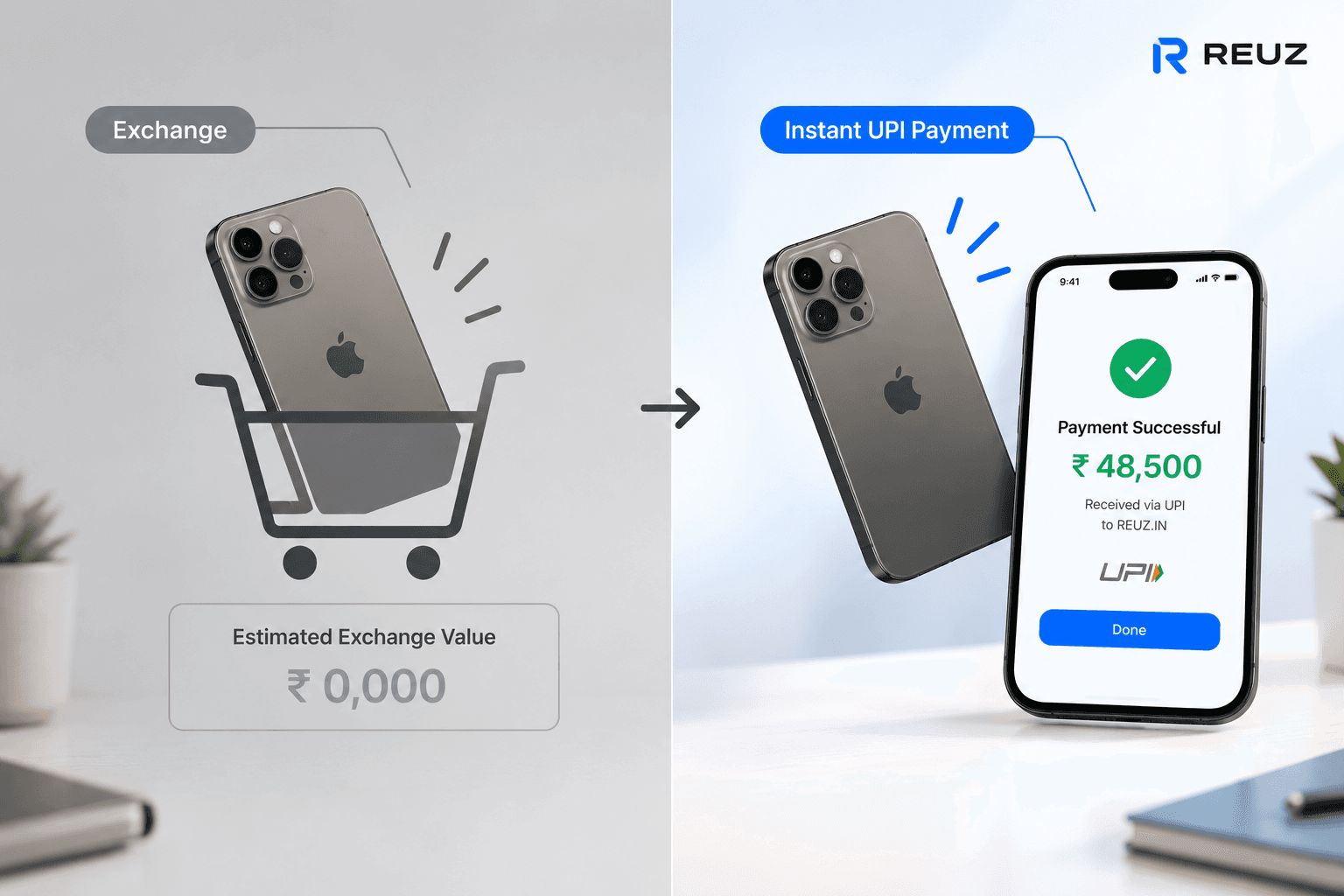
Cash via UPI or bank transfer |
Price revision at inspection |
|
E-commerce exchange (Flipkart, Amazon) |
Varies; festive exchange bonuses can stack |
At delivery |
Checkout credit only |
Device rejected at the door |
|
Store trade-in (Croma, Reliance Digital) |
Estimated 20–35% below market |
Same day |
Store credit only |
Locked into that retailer |
|
Local mobile shop |
Estimated 25–40% below market |
Immediate |
Cash |
No price transparency |
These are published industry estimates, not fixed rates — actual offers move with model, condition, storage variant and demand on the day. Treat the table as a ranking, not a quote.
Why does the same phone get five different prices?
It is not arbitrary. Every channel is buying something different from you.
● A private buyer is buying a phone. They pay close to what the device is worth because there is no middleman margin — but you absorb all the work and all the risk.
● A buyback platform is buying inventory. It has to inspect, grade, refurbish, warranty and resell your device, and it prices in that cost. In return you get certainty and instant payment.
● An exchange programme is buying a sale. Your old phone is a discount lever on a new purchase, which is why the value arrives as credit rather than cash.
● A store trade-in is buying footfall. The trade-in exists to get you into the store and out with a new device on their margin.
● A local shop is buying at whatever you accept. There is no published pricing, so the number depends entirely on how much you know before you walk in.
Understanding this tells you where to push. You can negotiate with a local shop. You cannot negotiate with an algorithm — but you can compare it against two others in five minutes.
The hidden costs nobody prices in
Peer-to-peer: your time and your risk. The 10–20% premium on OLX is real, but so is the two-to-six week wait, the lowball offers, and the fraud exposure. Marketplace sellers in India are routinely targeted with fake payment screenshots and UPI collect-request scams. For a mint flagship, the premium may justify the hassle. For a mid-range phone, it almost never does.
Exchange offers: the doorstep rejection. This is the cost most people never see coming. Exchange value is confirmed by a delivery agent at handover, and agents can be strict about scratches, screen marks and dents. If your phone is rejected at the door, you pay full price for the new device that day. Your ₹18,000 exchange discount evaporates at the exact moment you have no alternative.
Store trade-ins: credit that expires. Store credit is only worth face value if you were going to spend it there anyway, at that retailer's prices, within their validity window. Otherwise you have converted cash into a coupon.
Buyback platforms: the inspection gap. The genuine complaint about organised buyback is the quote that drops when the technician arrives. This is worth screening for. Ask whether the platform locks the quote, whether inspection happens in front of you, and whether you can decline at zero cost after inspection. Reuz, for example, offers a quote lock of up to seven days and confirms the final price in front of you before any payment or handover.
Myth vs reality
Myth: "Exchange offers give the best value because of the bonus."
Reality: Festive exchange bonuses can be genuinely competitive, especially when stacked with bank offers on the same platform. But the value is credit, it is contingent on your device passing inspection at the door, and it only exists if you complete the purchase. Compare the cash quote before you commit.
Myth: "OLX always pays more."
Reality: OLX pays more if a serious buyer turns up, if they don't negotiate you down, and if the payment is real. Published estimates of a 10–20% premium describe the listing price, not the average realised price after weeks of haggling.
Myth: "All buyback platforms quote the same number."
Reality: They vary widely, and the spread is largest on premium devices. Industry comparisons have described some large organised buyback quotes as sitting 15–25% below peer-to-peer levels. Getting two or three quotes takes minutes.
Myth: "The local shop gives instant cash, so it's simplest."
Reality: It is the simplest and usually the most expensive. Estimates place local shop offers 25–40% below market. Doorstep buyback is equally instant and does not require you to leave the house.
Which channel should you actually use?
|
Your situation |
Best channel |
Why |
|
Mint-condition flagship, no time pressure, comfortable vetting buyers |
Peer-to-peer, with strict payment rules |
The 10–20% premium is largest on premium devices |
|
Flagship or mid-range, want the money this week |
Doorstep buyback with above-market guarantee |
Best money-per-hour; cash, not credit |
|
Buying a new phone on Flipkart or Amazon in a festive sale |
Compare exchange bonus against a cash quote |
Bonuses sometimes win, but only with a stacked offer |
|
Cracked screen, battery fault or water damage |
Buyback platform that accepts damaged devices |
Private buyers avoid faults; platforms still make an offer |
|
Multiple old devices in a drawer |
Single buyback pickup for all of them |
One visit, one payment, no repeated listing effort |
|
Need money today, phone not in mint condition |
Doorstep buyback |
Same-day cash without the local-shop discount |
|
Compare before you accept anything. |
How to get the highest number from any channel
1. Know your baseline first. Pull one online quote before you talk to anyone. Walking into any negotiation without a number is how sellers get anchored low. Start with the iPhone or Samsung price pages.
2. Check the exact variant. Storage and RAM change the price materially. An incorrect variant in your quote guarantees a revision at inspection.
3. Check battery health before quoting. iPhone: Settings → Battery → Battery Health & Charging. Samsung: Settings → Battery and device care → Diagnostics.
4. Be honest about condition. Understating a scratch does not get you a better price; it gets you a lower revised price at the door and a wasted afternoon.
5. Find the box, bill and charger. Complete accessories and a matching IMEI on the box improve offers, especially on premium devices.
6. Do not repair before selling. A third-party screen replacement typically costs more than it adds back, and non-original parts can lower the grade.
7. Sell before the launch cycle, not after. Timing moves the number more than negotiation does. See our guide to phone depreciation and when to sell in India.
8. Get at least two quotes. Five minutes of comparison is the highest-return effort in this entire process.
Red flags in any selling channel
● Anyone who asks you to scan a QR code or enter your UPI PIN "to receive" money. You never enter a PIN to receive.
● A platform that will not tell you the final price before you hand over the device.
● A buyer who wants the phone couriered before payment clears.
● A quote that is dramatically above every other quote — it usually gets "revised" at inspection.
● Any request for an advance, deposit or courier fee from the seller's side.
● Store credit with an expiry date you have not read.
The bottom line
There is no single best place to sell an old phone in India — there is a best channel for your specific combination of device, condition, urgency and appetite for hassle. Peer-to-peer pays the most and costs the most in time and risk. Store trade-ins and local shops pay the least. Exchange offers are competitive only when you are buying anyway and your device passes inspection at the door. Doorstep buyback sits where most sellers actually want to be: near the top of the payout range, same day, in cash, with no obligation to buy anything.
Whatever you choose, get more than one number first. That single habit is worth more than every negotiation tactic combined.
|
Get your comparison number in 60 seconds. |
Published by Reuz.in — India's transparent smartphone buyback platform. Free doorstep pickup, inspection in front of you, instant UPI payment. Channel payout estimates cited from published 2026 industry comparisons and platform disclosures; actual offers vary by model, variant and condition.