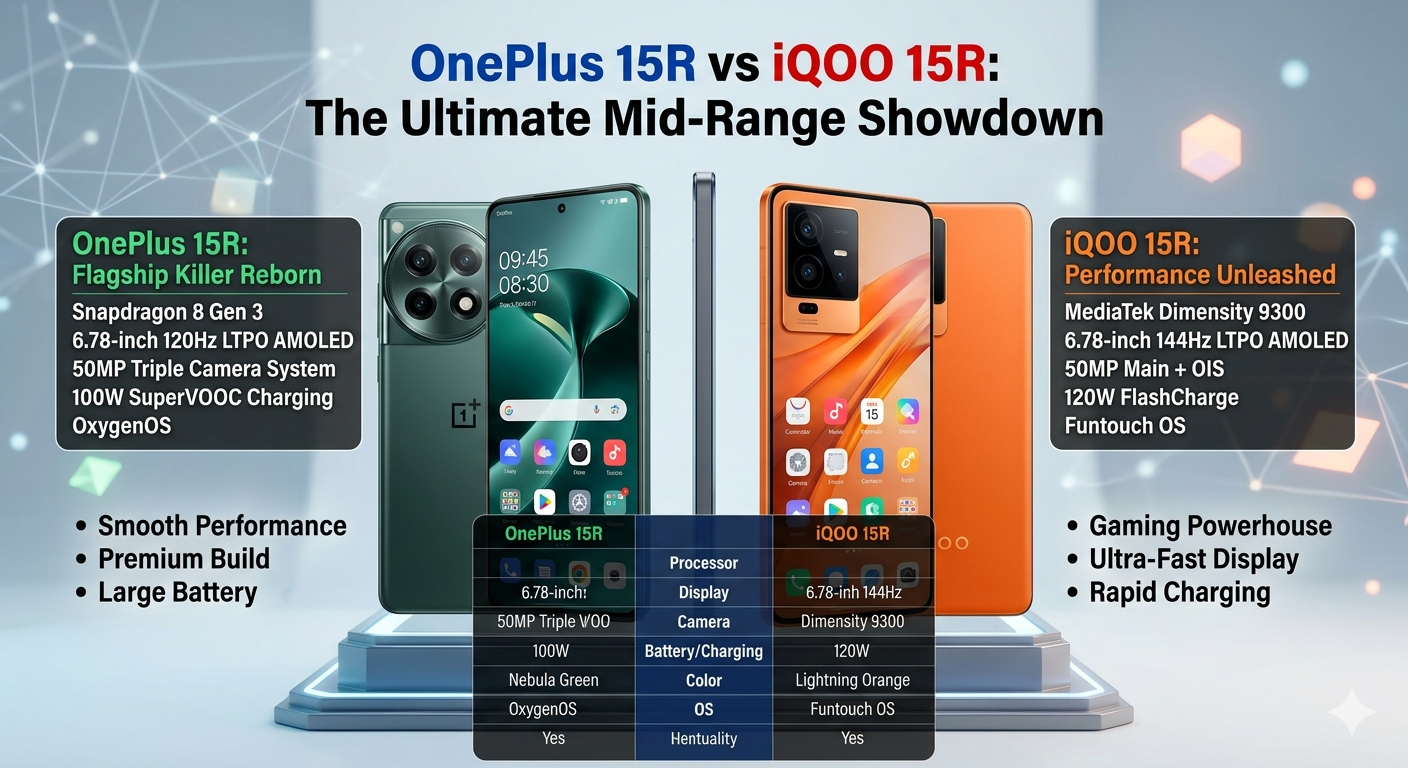
Two phones. One chip. Completely different personalities. We've broken down every spec, trade-off, and real-world difference so you can walk away knowing exactly which phone to buy — and why.
This is where the two phones reveal their personalities. OnePlus goes bigger and smoother; iQOO goes brighter and more compact. It's a genuine fork in the road depending on how you use your phone.
| 6.83-inch AMOLED 1.5K Larger screen |
Screen size | 6.59-inch AMOLED 1.5K |
| 165Hz adaptive Smoother |
Refresh rate | 144Hz |
| 3,600 nits peak | Brightness | 5,000 nits peak Brighter outdoors |
| 3,200Hz touch sampling Gaming edge |
Touch response | Standard touch chip |
| Corning Gorilla Glass 7i | Glass protection | Schott Xensation Alpha |
| Dolby Vision, HDR10+ | HDR support | HDR10+, 4320Hz PWM dimming |
Who wins? If you play BGMI, Call of Duty Mobile, or Genshin Impact competitively, the OnePlus 15R's 165Hz refresh and 3,200Hz touch sampling chip give your thumbs a real, measurable edge. But if you're constantly outdoors in harsh Indian sunlight, the iQOO's 5,000 nits display is simply unmatched at under ₹50,000. Also, the 4,320Hz PWM dimming on the iQOO is a genuine comfort win if you're sensitive to eye strain during long sessions.
Both phones carry the same Snapdragon 8 Gen 5 — the most powerful mainstream Android chip of 2025-26. But the differences beneath the surface matter more than you'd expect.
| Snapdragon 8 Gen 5 | Chipset | Snapdragon 8 Gen 5 |
| Adreno 840 Higher-end GPU |
GPU | Adreno 826 |
| Up to 16GB LPDDR5X Ultra Exclusive 16GB option |
RAM | Up to 12GB LPDDR5X Ultra |
| Up to 512GB UFS 4.1 | Storage | Up to 512GB UFS 4.1 |
| ~2.9M AnTuTu | Benchmark | ~3.5M AnTuTu Q2 gaming chip boost |
| ~42°C after 30min gaming | Thermal (gaming) | Under 40°C (6.5K VC cooling) Cooler under load |
Who wins? The iQOO scores higher in raw benchmarks because of its dedicated Q2 gaming chip and a massive 6.5K vapour chamber cooling system. However, the OnePlus uses a better GPU (Adreno 840) and offers an exclusive 16GB RAM variant at ₹52,999 — the same price as iQOO's 12GB top model. For video editors, power multitaskers, and developers with 30+ apps open, that extra RAM is genuinely valuable. Day-to-day, both feel identically fast.
On paper, these cameras look almost identical. In practice, the OnePlus has a clear video advantage that matters enormously for creators.
| 50MP Sony IMX906 + OIS | Primary camera | 50MP Sony LYT-700V + OIS |
| 8MP ultra-wide | Wide camera | 8MP ultra-wide |
| 4K @ 120fps (rear) True cinematic slow-mo |
Rear video | 4K @ 60fps (rear) |
| 32MP, 4K@30fps + Autofocus Sharper selfies |
Selfie camera | 32MP, 4K@60fps Higher front fps |
| Detail Max Engine + AI processing | AI camera | Standard AI modes |
Who wins? The OnePlus 15R wins on video versatility — 4K@120fps means you can slow footage down to stunning 4x slow motion in full resolution. The autofocus on the selfie camera also means sharper, better-framed solo shots. The iQOO's trump card is its front camera shooting 4K@60fps — great for vloggers who alternate between front and rear cameras and want matching quality from both. For still photography, both sensors are excellent and daily results will be very similar.
This is the iQOO's clearest victory. It has a bigger battery AND faster charging — not a small gap.
| 7,400 mAh | Battery | 7,600 mAh 200mAh larger |
| 80W SuperVOOC | Wired charging | 100W fast charging ~35 min full charge |
| ~13+ hours screen-on time Tested, verified |
Battery life | Expected 14+ hours Larger battery + same chip |
| ~55 min to full charge | Charge time | ~35 min to full charge |
Who wins? iQOO, decisively. The 100W vs 80W charging gap is 20 minutes of real time every time you charge. In India's busy mornings and long commutes, that matters a lot. If you're the kind of person who plugs in while getting ready and needs a full phone in 30 minutes, the iQOO is engineered for you. The OnePlus's 80W is still fast — just not as fast.
| 213g, 8.3mm thick | Weight / build | 202g, 7.9mm slim Lighter & thinner |
| IP66 + IP68 + IP69 + IP69K Most comprehensive |
Water resistance | IP68 + IP69 |
| Electric Violet, Fluid Silver, Black More colour options |
Colour variants | Dark Knight, Triumph Silver |
| OxygenOS 16 — clean, no ads, no bloatware Better user experience |
Software | Origin OS 6 (Android 16) — customisable but has bloatware |
| Alert Slider for quick modes | Unique features | Special notification styles, themes |
| 4 yrs Android + 6 yrs security | Update support | 4 yrs Android + 6 yrs security |
Who wins? The iQOO is lighter and slimmer — easier to hold for long sessions. But OnePlus wins on software by a comfortable margin. OxygenOS 16 is clean, close to stock Android, zero ads, and minimal bloatware. Origin OS 6 is more customisable but comes with pre-installed apps and a busier interface. If you've never enjoyed fiddling with phone settings, OnePlus is the straightforward, premium experience. If you love customising notifications, themes, and gestures — iQOO gives you more tools to play with.
| Specification | OnePlus 15R | iQOO 15R |
|---|---|---|
| Starting price | ₹47,999 | ₹44,999 |
| Display | 6.83" AMOLED 1.5K | 6.59" AMOLED 1.5K |
| Refresh rate | 165Hz adaptive | 144Hz |
| Peak brightness | 3,600 nits | 5,000 nits |
| Chipset | Snapdragon 8 Gen 5 | Snapdragon 8 Gen 5 |
| GPU | Adreno 840 | Adreno 826 |
| RAM | 12GB / 16GB LPDDR5X | 8GB / 12GB LPDDR5X |
| Storage | 256GB / 512GB UFS 4.1 | 256GB / 512GB UFS 4.1 |
| Primary camera | 50MP Sony IMX906 + OIS | 50MP Sony LYT-700V + OIS |
| Ultra-wide | 8MP | 8MP |
| Rear video | 4K @ 120fps | 4K @ 60fps |
| Selfie camera | 32MP, 4K@30fps + AF | 32MP, 4K@60fps |
| Battery | 7,400 mAh | 7,600 mAh |
| Charging | 80W SuperVOOC | 100W fast charging |
| Water resistance | IP66+IP68+IP69+IP69K | IP68 + IP69 |
| Glass (front) | Corning Gorilla Glass 7i | Schott Xensation Alpha |
| Weight | 213g | 202g |
| Thickness | 8.3mm | 7.9mm |
| Touch sampling | 3,200Hz (dedicated chip) | Standard |
| Software | OxygenOS 16 (Android 16) | Origin OS 6 (Android 16) |
| OS updates | 4 years | 4 years |
| Security updates | 6 years | 6 years |
The iQOO 15R punches hard on value. It starts ₹3,000 cheaper, has a bigger battery, charges faster at 100W, is slimmer, lighter, and hits 5,000 nits of outdoor brightness. If battery life, charging speed, and upfront price are your top three priorities, the iQOO wins without question. It's also the better pick if you're someone who actually enjoys customising their phone software deeply.
The single deciding question: Do you spend more time gaming and watching content, or are you always away from a charger and need your phone to last and charge fast? Your answer tells you which phone to buy.
Prices as of April 2026 · Specs sourced from official brand announcements and Smartprix · Always verify current pricing before purchase
Real questions buyers ask before spending ₹45,000–₹53,000 on a phone — answered honestly.
Prices as of April 2026 · Specs sourced from official brand announcements and Smartprix · Always verify current pricing before purchase