India Smartphone Market Share 2025: A Year of Premium Growth
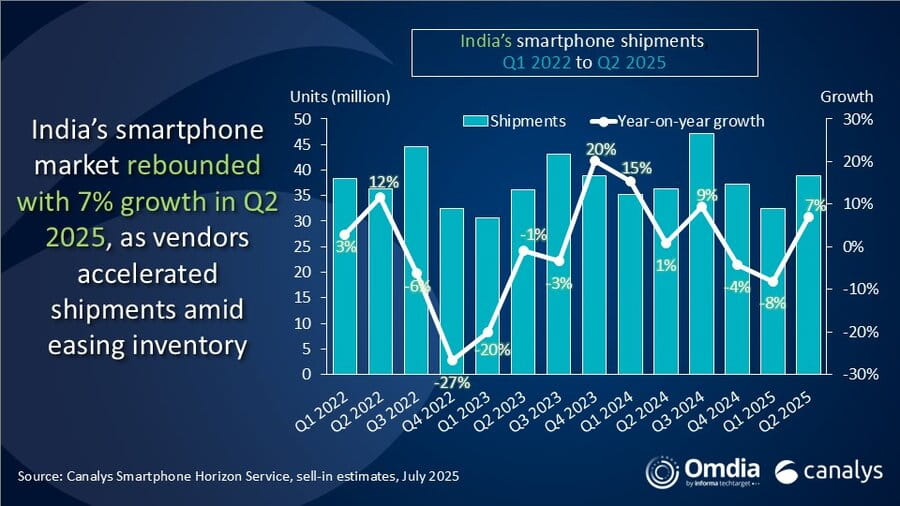
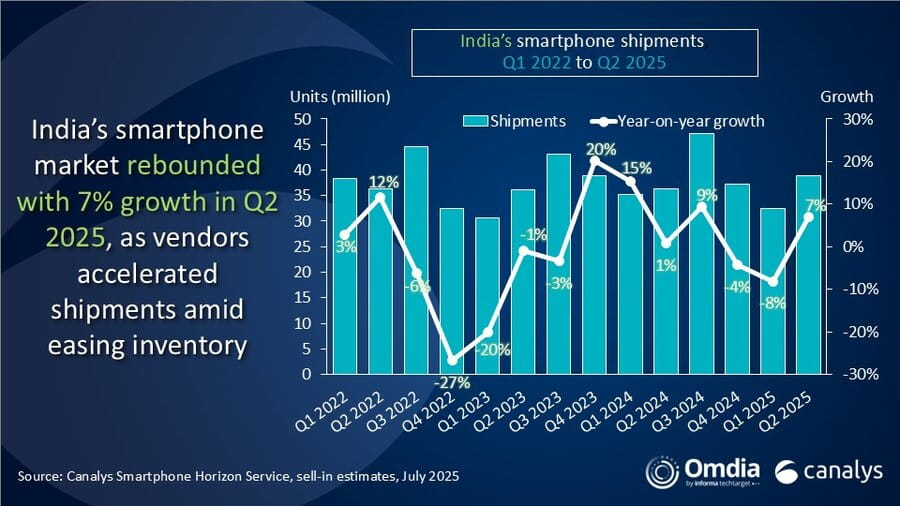
The India smartphone market experienced a transformative year in 2025, with manufacturers shipping approximately 154.2 million units—a modest 1% decline from 2024. However, beneath this flat growth lies a compelling story of market segmentation, with premium devices gaining significant traction while budget segments face headwinds. This shift has reshaped the competitive landscape, creating new opportunities for brands that cater to affluent consumers.
Market Leaders: Who Dominates India's Smartphone Landscape?
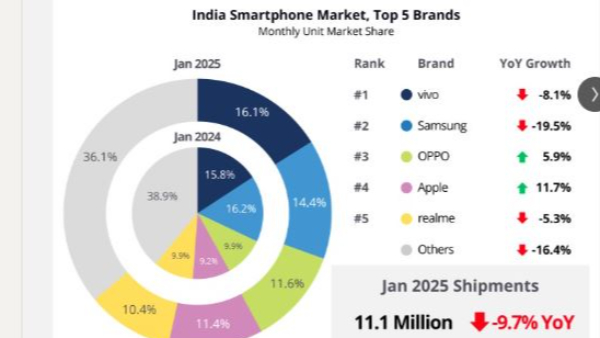
When examining smartphone market share India, the data reveals a clear hierarchy of players. Vivo emerged as the undisputed market leader, capturing a commanding 23% share with approximately 32.1 million shipments in 2025. This represents impressive 19% year-over-year growth, solidifying Vivo's position as the primary pull brand for both consumers and retailers.
Top 5 Smartphone Vendors by Market Share (2025)
- Vivo: 23% market share (32.1 million units) – Growth of 19% YoY
- Samsung: 15% market share (23 million units) – Decline of 11% YoY
- Xiaomi: 13% market share (19.7 million units) – Decline of 26% YoY
- OPPO: 13% market share (20 million units) – Growth of 10% YoY
- Apple: 10% market share (15.1 million units) – Growth of 28% YoY
While Vivo, Samsung, and Xiaomi command the volume game, the narrative shifts dramatically when examining growth trajectories and market positioning.
Apple's Remarkable Rise in India's Premium Segment
Perhaps the most significant story of 2025 involves Apple iPhone India performance. Despite remaining outside the top three vendors by shipment volume, Apple achieved a historic milestone by capturing a record 9% market share—up from 7% in 2024. The company shipped approximately 14-15.1 million units throughout the year, representing an extraordinary 28% growth rate.
This surge underscores Apple's successful penetration of India's emerging premium smartphone segment. While budget-conscious consumers continue to dominate overall volume metrics, affluent buyers increasingly opt for iPhones, driving Apple's expansion without matching the raw unit numbers of mass-market competitors. The strong demand for the iPhone 17 base model particularly contributed to this momentum, as consumers anticipate demand-generation offers on older iPhone 15 and 16 models.
Why Apple's Growth Matters for the Market
Apple's 28% growth rate—the highest among major vendors—signals a fundamental shift in India's smartphone purchasing behavior. As disposable incomes rise and consumers increasingly value ecosystem integration, brand prestige, and long-term software support, premium smartphones are capturing an expanding slice of the market. This trend directly challenges the long-standing dominance of budget-focused Chinese manufacturers.
The Premium vs. Budget Divide: Understanding Market Segmentation
The divergence between volume leaders and growth champions reflects a critical segmentation within the India smartphone market. Chinese manufacturers like Vivo, Xiaomi, and OPPO dominate through aggressive pricing and extensive offline retail networks targeting consumers under ₹25,000 ($300). Conversely, Apple and Samsung have carved out substantial positions in the ₹25,000–₹60,000 and ₹60,000+ segments respectively.
This bifurcation has intensified due to rising memory costs, which have compressed margins in the budget segment while creating opportunities for brands with stronger premium portfolios. Manufacturers facing cost pressures have responded by scaling back cashback offers, reducing specifications, or increasing prices—moves that inadvertently accelerate the shift toward premium devices among cost-sensitive consumers seeking better long-term value.
Fourth Quarter 2025: Market Momentum and Seasonal Dynamics
The final quarter of 2025 revealed important seasonal patterns within the India smartphone market. Overall shipments declined 7% quarter-over-quarter to 34.5 million units, reflecting typical post-festive season slowdown compounded by elevated channel inventories and a depreciating rupee.
Q4 2025 Market Share Leaders
- Vivo: 23% share (7.9 million units) – Growth of 16% YoY
- Samsung: 14% share (4.9 million units) – Decline of 11% YoY
- OPPO: 13% share (4.6 million units) – Growth of 10% YoY
- Xiaomi: 12% share (4.2 million units) – Decline of 26% YoY
- Apple: 11% share (3.9 million units) – Decline of 1% YoY
Apple's resilience during the challenging Q4 period—declining only 1% compared to Q4 2024—demonstrates strong underlying demand for iPhones. Meanwhile, Vivo and OPPO's double-digit growth underscores their exceptional retail execution and inventory management capabilities.
Key Market Drivers and Consumer Behavior Shifts
Several factors shaped the 2025 shipments landscape in India:
- Rising Memory Costs: Inflation in semiconductor prices compressed margins, particularly affecting budget-segment manufacturers and prompting strategic price increases across the market.
- Elongated Replacement Cycles: Consumers increasingly defer upgrades, waiting for promotional offers and meaningful feature improvements—a trend that benefits established brands like Apple and Samsung.
- Offline Retail Dominance: Brands with deep offline penetration, extensive promoter networks, and localized execution strategies significantly outperformed volume-led approaches. Vivo's decentralized, agent-led operating model proved particularly effective.
- Cautious Consumer Spending: Economic uncertainty and inflation concerns have made consumers more selective, favoring value-driven strategies and established ecosystems.
- Premium Portfolio Strength: Brands offering compelling premium options gained disproportionate market share growth despite overall market contraction.
2026 Outlook: What Counterpoint Research and Industry Analysts Predict
Looking ahead, the 2026 forecast presents a more challenging environment for India's smartphone manufacturers. Counterpoint Research and Omdia both project mid-single-digit market contraction, with shipments expected to decline approximately 5% from 2025 levels.
Key Predictions for 2026
- Market Contraction: Smartphone shipments expected to decline mid-single-digits due to higher prices and delayed upgrade cycles.
- Memory Cost Pressures: Continued inflation in memory components will constrain hardware-led differentiation, forcing brands to compete on channel execution, financing options, and ecosystem bundling rather than raw specifications.
- Segment Rebalancing: Entry-level Chinese OEMs will pivot toward the ₹25,000–₹60,000 'flagship killer' segment, where margin protection against rising costs is more achievable. The ₹60,000+ segment will remain structurally led by Apple, Samsung, and Vivo.
- Retail Execution Critical: Success in 2026 will increasingly depend on promoter strength, inventory support, localized sell-through programs, and innovative financing rather than headline innovation.
- Policy Support Potential: Government incentives and policy measures could stabilize demand in the second half of 2026, providing growth opportunities for well-positioned brands.
Strategic Implications for Major Players
Apple's Path Forward
Apple's strong performance positions it well for continued growth in India's premium segment. The anticipated launch of the iPhone 17e—a more affordable premium device—could significantly expand the addressable market and drive further market share gains. Apple's ecosystem strength, software support longevity, and brand prestige provide sustainable competitive advantages even amid rising component costs.
Vivo's Dominance Strategy
Vivo's continued leadership relies on its retail-first execution model, extensive offline presence, and ability to deliver compelling value at various price points. The brand's success with models like the Y31 5G, Y19s 5G, T4X 5G, and V60e demonstrates effective product-market fit and supply chain optimization.
Samsung's Recovery Challenges
Samsung faces headwinds from price competition and shifting consumer preferences toward Chinese brands in the mass market while competing with Apple in the premium segment. The company's 11% shipment decline in 2025 signals the need for renewed strategic focus on differentiation and value proposition.
Xiaomi's Turnaround Opportunity
Xiaomi's 26% decline represents the most significant challenge among major vendors. The brand must reassess its product portfolio, pricing strategy, and retail execution to regain competitive momentum in an increasingly segmented market.
Conclusion: A Market in Transition
The India smartphone market in 2025 demonstrated that volume leadership and growth don't always align. While Vivo commands the largest shipment share, Apple achieved the highest growth rate by capturing expanding premium demand. This divergence will likely intensify in 2026 as memory cost pressures force further market segmentation and reward brands with disciplined portfolio management and strong retail execution.
For consumers, this transition presents an opportunity to access better-quality devices at various price points. For manufacturers, success increasingly depends on understanding local market dynamics, building robust offline channels, and delivering genuine value rather than simply competing on specifications or raw unit volumes.
Frequently Asked Questions
Q1: Which company leads the India smartphone market in 2025?
Vivo leads the India smartphone market with a 23% market share and approximately 32.1 million shipments in 2025, followed by Samsung at 15% and Xiaomi at 13%.
Q2: What is Apple's market share in India for 2025?
Apple achieved a record 9% market share in India during 2025, shipping approximately 14-15.1 million units and representing 28% year-over-year growth—the highest growth rate among major vendors.
Q3: How did the India smartphone market perform overall in 2025?
The India smartphone market shipped 154.2 million units in 2025, marking a modest 1% annual decline. While overall volumes remained relatively stable, the market showed clear signs of maturation with a shift toward premium devices and value-driven strategies.
Q4: Why is Apple growing faster than Vivo despite lower market share?
Apple's rapid growth reflects increasing demand for premium smartphones among affluent Indian consumers, while Vivo's leadership comes from dominating the high-volume mass market. These represent different market segments with distinct growth dynamics.
Q5: What challenges does the India smartphone market face in 2026?
The 2026 forecast predicts mid-single-digit market contraction due to higher prices, elongated replacement cycles, and rising memory costs. Manufacturers will need to focus on retail execution, financing options, and ecosystem bundling rather than hardware specifications alone.
Q6: Which smartphone segment is growing fastest in India?
The premium smartphone segment (₹25,000+) is growing fastest, driven by rising disposable incomes, ecosystem preferences, and consumers seeking long-term software support. This trend benefits brands like Apple, Samsung, and Vivo.
Q7: How have rising memory costs affected the India smartphone market?
Rising memory costs have compressed margins in the budget segment, prompting manufacturers to scale back cashback offers, reduce specifications, or increase prices. This has inadvertently accelerated the shift toward premium devices among cost-conscious consumers.
Q8: What role does offline retail play in India's smartphone market?
Offline retail is critical to success in India, with brands featuring extensive promoter networks, localized execution, and inventory support significantly outperforming volume-led approaches. Vivo's offline-first strategy has been particularly effective.
Q9: Which Apple iPhone model performed best in India during 2025?
The iPhone 17 base model drove strong demand in India during 2025, as consumers sought more affordable entry points into Apple's ecosystem while anticipating promotional offers on older iPhone 15 and 16 models.
Q10: What is the forecast for India's smartphone market in 2026?
Industry analysts forecast mid-single-digit market contraction (approximately 5%) in 2026 due to higher prices and delayed upgrade cycles. However, potential government policy support and strong seasonal demand in the second half could stabilize growth.